The Peacock's Tail
Why AI will make everything cheaper except what humans actually want.


I. The Abundance Argument
When discussing how AI will impact society, people generally point to two extreme, opposite scenarios. One paints a picture of a dystopian society where commoners are ruled by superintelligent overlords, while the other envisions an ultra-utopian scenario where humanity is freed from work and labor, ushering in an age of infinite abundance.
While this topic has been debated by philosophers for a century, the first scenario is inherently dark. However, lately on the internet, even the “good” scenario has created a strange tension among observers.
Proponents argue that AI will generate infinite abundance, freeing humanity from labor. Yet, an individual in today’s society largely derives their self-worth from the economic output they generate. Pushing humans out of the economic cycle feels like disenfranchising them from meaning itself. This looming threat of irrelevance is why the AI shift feels fundamentally different from regular, systemic unemployment.
Still, the irrelevance debate misses a major point about what humans actually want. When we talk about abundance, what we really mean is that our basic needs will be taken care of. I want to argue that, for a huge portion of the population, they already are.
II. Abundance Is Already Here
When we talk about AI creating abundance, we’re really talking about the cost of stuff trending toward zero. But this process isn’t speculative. It’s not even futuristic. In India, you can watch it unfold in real time, within a single generation.
Consider food. If you were born in 1960 in India, you spent roughly 70% of your household income on food. Survival was expensive. Today, the average Indian household spends about 30% on food. This isn’t because we’re eating less; calorie consumption has actually risen. It’s because food has become genuinely, historically cheap relative to income. The Public Distribution System alone covers 800 million people, more than twice the population of the United States, with subsidized grain. That’s not a utopian fantasy. That’s Tuesday.
Consider connectivity. In 2016, 1GB of mobile data in India cost around 250 rupees. Today, you can get 1GB for under 10 rupees. For 250 rupees now, you get roughly 50GB. This is not a marginal improvement. It’s a 50x price collapse in less than a decade.
This is the argument: abundance is not a futuristic promise. It's the accumulated inheritance of industrialization, globalization, and now digitization.
Consider what this adds up to. The basket of goods and services that kept your grandparents alive consumed almost all their energy to acquire. The basket that keeps you alive - more food, more information, more connectivity, more financial access - consumes a fraction of your income and attention. The surplus—of time, of money, of cognitive bandwidth—is the abundance. It’s already here. It just doesn’t look like flying cars.
III. If Abundance Is Here, Why Doesn’t It Feel Like Utopia?
The pushback is obvious: if abundance is here, why does everything feel so expensive? Because the things that feel expensive are precisely the things abundance doesn’t touch -
housing in a desirable neighborhood
a seat at a top college
a table at a famous restaurant
These are not contradictions to the abundance thesis. They are exactly what the thesis predicts. The stuff that can be mass-produced like data, grain or compute gets cheap. The stuff that can’t, because it’s tied to land, to human attention, to institutional prestige gets expensive. Your roti is cheap. Your rent in Bandra is not.
So when we ask whether AI will bring abundance, the answer is: it will finish what the industrial revolution and the digital revolution started. It will make the already-cheap things even cheaper. But it will not touch the things that have always been scarce, because those things were never scarce for technological reasons in the first place.
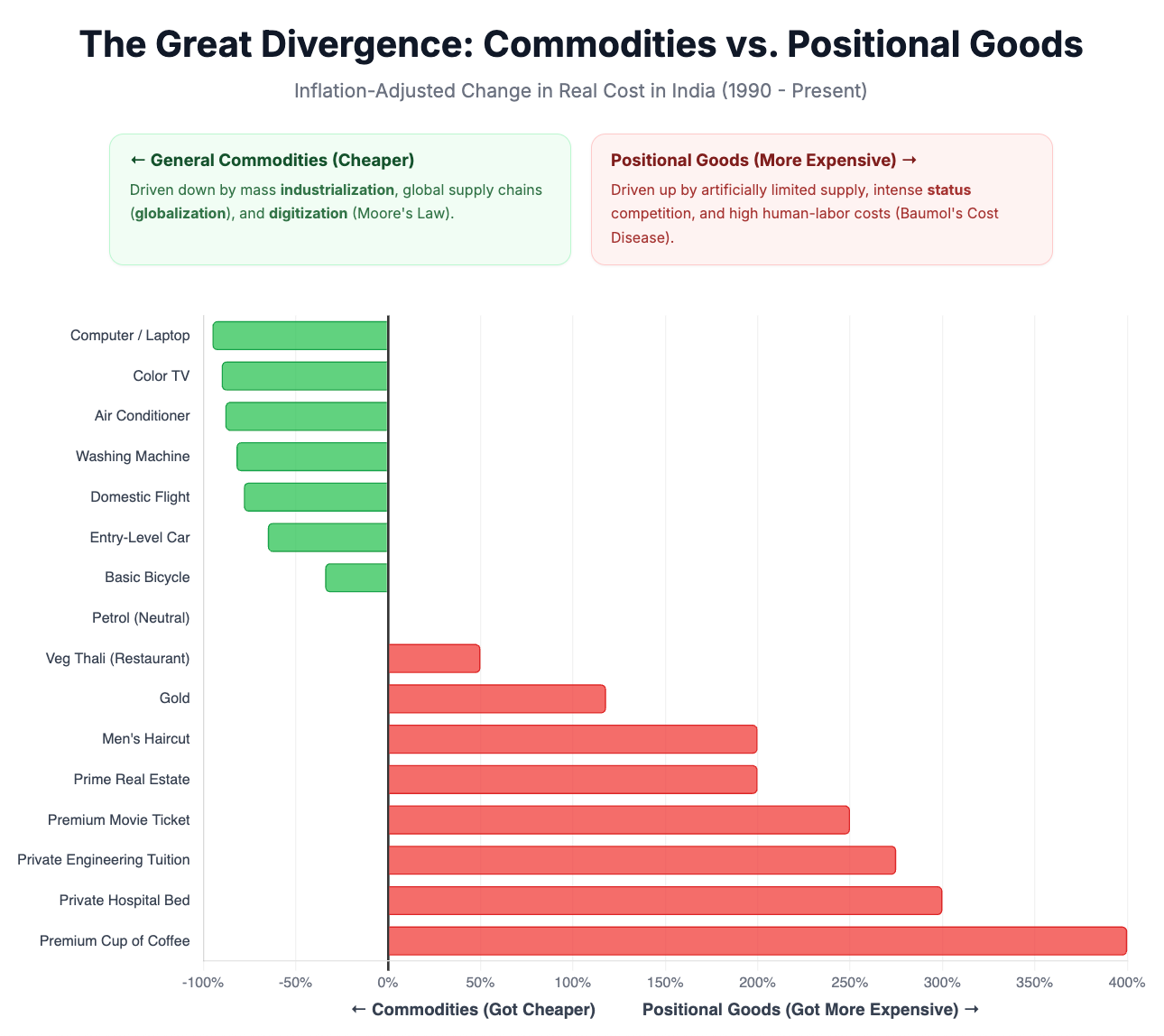
And this is why it doesn’t feel like an Utopia. Because the premise, that deflation of commodities leads to psychological well-being is wrong. It misunderstands what humans are actually optimizing for—
We assumed the goal of society was to maximize comfort. But the goal of the individual is to maximize status.
Most of modern human pursuit is not about acquiring better commodities. It’s about signalling position. After a point, consumption becomes consumption for status. Status is scarce by nature. It cannot be distributed equally through UBI(Universal Basic Income). You can solve income. You cannot solve meaning.
IV. Status Is Zero-Sum By Evolutionary Necessity
Status is zero-sum by definition. For someone to gain it, someone else has to lose it. There is no way to manufacture more of it.
Why?
The origin of status is mating. In sexual selection for ‘survival of the fittest’, to select, there must be a hierarchy. Where there is a hierarchy, individuals will compete to climb it. The basis of hierarchy shifts — it was once raw physical strength, today it’s some combination of beauty, money, intelligence, anything that signals genetic vitality — but the hierarchy itself is constant.
How are status markers decided?
In biology, a signal of fitness must be costly to be credible. The peacock’s tail works as a signal precisely because it is wasteful. It says: Look at this massive, ridiculous weight I am dragging around. Look at how easily predators can spot me. And yet, my immune system, my speed, and my foraging skills are so incredibly superior that I am still alive despite this massive handicap.
The moment something becomes easy or cheap, it stops functioning as a status signal.
If AI makes a skill effortless, that skill is immediately devalued as a marker of worth. Humans will migrate to whatever remains hard. The treadmill never stops.
This is the critical insight:
Hierarchy is not a bug of human society. It is a feature of sexual selection. It cannot be engineered away.
V. AI Changes The Arena, Not The Game
AI will reshape what we compete over, but not the fact that we compete. Consider where this plays out:
‘Positional goods’ cannot be manufactured. Some goods are inherently scarce — a house in a desirable neighbourhood, a seat at a top university, a table at a famous restaurant. Supply is fixed. AI cannot build more land in South Mumbai or create another seat at IIT Bombay. As incomes rise from AI-driven productivity, positional goods don’t get cheaper. They get more expensive. This is already happening with real estate, elite education, concert tickets and exclusive offline events.
VI. Humans Compete With Humans, Not Machines
From an economic output standpoint, sports are useless. Chess is useless. Bodybuilding is useless.
The best chess player has been an AI for over a decade. The strongest lifter on earth is a crane. Yet the top human chess players, bodybuilders, and artists command respect, status, and money.
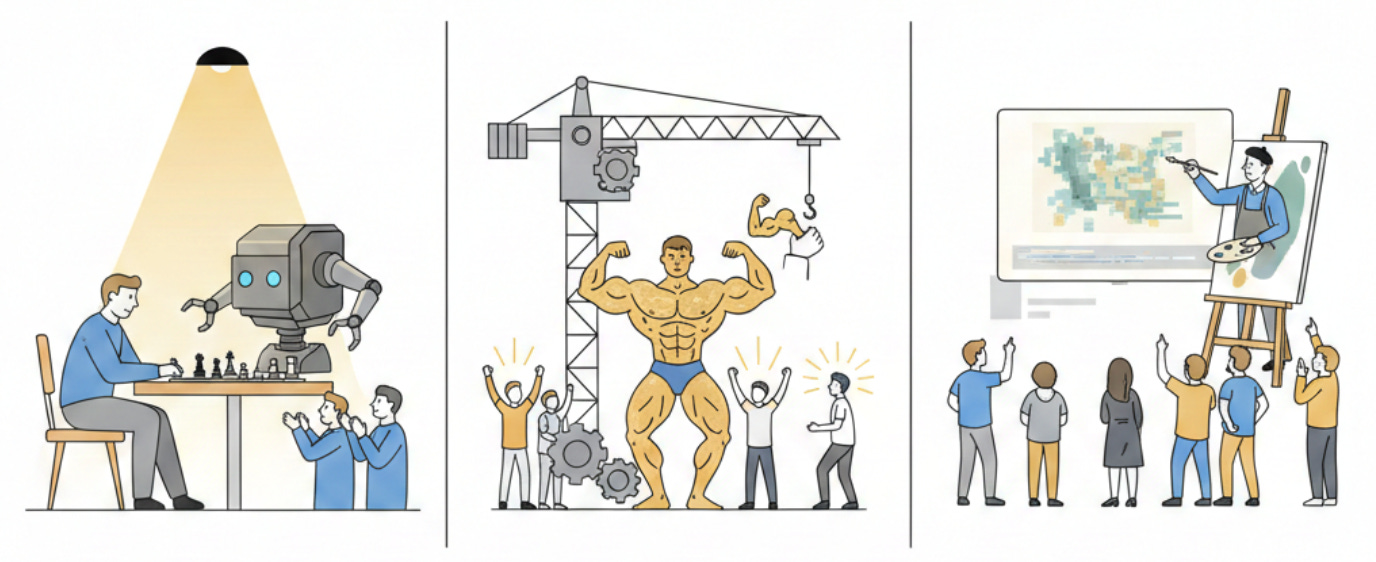
Is this a lag in adaptation? Probably not. Humans have valued physical strength for 200 years after machines surpassed us in raw power. There is no reason to believe we won’t continue to value human intelligence long after AI surpasses us there, too.
Humans compete with humans, not with non-humans. That’s the rule. The invention of the gun didn’t reduce fistfights. The invention of the crane didn’t kill bodybuilding. The invention of AI won’t kill human intellectual competition. We will simply create more arenas — more games, more art forms, more fields with their own hierarchies, and those arenas become the source of individual purpose.
“Human-made” and “no-AI” will become luxury labels, the way “organic” and “handcrafted” did.
We already see this with mechanical watches—they keep worse time than a $10 quartz watch, but sell for $10,000 because of the inefficient human labour involved.
One more constraint people forget: humans can maintain roughly 150 meaningful relationships. No technology has ever changed this. Global status — followers, fame — is largely a mirage. Most people compete for status within their local circle: their gym, their office, their friend group. The bodybuilder at your gym doesn’t care about cranes. He cares about the other bodybuilders at the gym. This local status game is ancient, persistent, and immune to technological disruption. AI won’t change it either.
VII. Where does this leave us?
The bright side: Not everyone is rich, but everyone is wealthier in absolute terms than at any point in history. The individual has never been this empowered. Cheap intelligence is to the mind what the gun was to strength. The invention of the gun made physical power worthless as a requirement for violence; a small person with a gun could defeat a large person. Similarly, cheap AI makes raw intelligence worthless as a requirement for output. A single person with AI can now produce what once required a team. The playing field flattens in absolute capability.
The dark side: The gun analogy breaks down in one important way. The gun was cheap. It stayed cheap. That’s what made it an equalizer. AI might not. If better AI requires more capital, then the owners of compute infrastructure, the data centers, energy grids, chip fabrication etc. become the new feudal lords. Everyone else rents intelligence from them. AI starts as an equalizer but risks consolidating into something closer to land ownership: whoever controls the compute controls the leverage. The individual is empowered only as long as intelligence remains cheap and accessible.
VIII. Conclusion: Meaning Is Not Going Anywhere
In either case, the loudest fear about AI isn’t economic. It’s existential. If AI can do everything better than us, what’s the point of being human? But this question contains a false assumption: that human meaning was ever derived from being the best at something in absolute terms. It wasn’t.
Meaning comes from struggle within a peer group. The amateur marathon runner is not racing against a car. The local chess club player is not competing against Stockfish. The startup founder is not measuring herself against an AI that could build the same product faster. They are competing against other humans within a circle of roughly 150 people whose opinions they actually care about. That’s where meaning lives, not in being the best in the world, but in being respected by your tribe.
AI doesn’t touch this. It can’t. The games will change. The urge to play them won’t.
Humans have found meaning in physical competition for centuries after machines made human strength irrelevant. We will find meaning in intellectual and creative competition for centuries after machines make human intelligence irrelevant.
Meaninglessness is not the default state that we fall into when work disappears. It’s a temporary disorientation between one game ending and the next one beginning.
— written with ❤️ by a human